

How to Get Coaching Clients Consistently
"I know I'm good at what I do, but nobody knows I exist." If you've said that, you're probably not a beginner. You have clients, some of them have stayed for years, and your income is real. Almost all of it came from people who already knew you: former colleagues, friends of friends, one referral that turned into three.
Then the introductions slowed. Nobody did anything wrong. Your network ran out of people who need you right now, and the referrals that used to arrive every few weeks now arrive when they feel like it.
This is where most coaches reach for more effort. I'd argue for something less exhausting: a client acquisition system, meaning two or three repeatable lead sources plus the capture and follow-up behind them, so clients keep arriving whether or not you posted this week.
Here's how to get coaching clients consistently once the warm network is used up: which sources hold up, which ones work without social media, and how to stop losing the leads you already have.
Why do referrals and your network run dry?
Which growth stage are you in?
The lead-source mix that holds up
Proof does the selling before you do
How to get coaching clients without social media
Stop losing the leads you already have
A worked example from my own practice
Get the free D6R Growth Blueprint
How do I get high-ticket coaching clients?
What is the fastest way to get clients?
How do coaches get clients without social media?
Key Takeaways
Referrals and your network run dry because they're a fixed pool on someone else's timetable, not because you did anything wrong.
Consistent clients come from two or three repeatable sources you can start yourself, not from stacking more tactics.
Pair one fast source that uses warm relationships with one slow source that compounds, and give both at least 90 days.
You don't need social media. Past clients, referral partners, podcasts, workshops, search articles and an email list all work without it.
Most practices lose more clients to slow or missing follow-up than to a shortage of leads, so fix capture and follow-up before buying more attention.
Why do referrals and your network run dry?
Referrals and your network run dry because both are finite, and neither is something you can switch on when you need a client.
Your network is a fixed list of people. Early on it holds everyone who already trusted you, so the first clients come easily. Once the people who needed you have hired you, the list doesn't refill on its own.
Referrals have a different problem: timing. A referral depends on a happy client meeting someone with your exact problem, remembering your name in that moment, and making the introduction. That chain does happen. You just can't schedule it, which is why referral-driven practices swing between full months and empty ones.
The field is also more crowded than it was. The 2025 ICF Global Coaching Study counted 122,974 coach practitioners worldwide, up 15% since 2023. More coaches means more people waiting on the same introductions inside the same networks.
None of this makes referrals bad. They're often your best-fit, fastest-closing clients. The mistake is letting them be your only source, because then your income depends on other people's memory and timing.
You can make the referrals you do get less random. When a client reaches a clear win, give them a one-page referral note: who you help, in plain words, the two or three changes you work on, and how to make an introduction. Most people who want to refer you don't know what to say, and the page says it for them.

Which growth stage are you in?
Most coaches who've outgrown their network sit in one of three stages, and the stage tells you what to fix first.
Stage | What it looks like | How it feels |
|---|---|---|
Stage 1: Hustle | Every client comes from your own effort and your own network. There's no process, only you. | You're the ceiling of your own business. |
Stage 2: Tools & Chaos | You've bought a CRM, a scheduler and an email tool. None of them talk to each other. | You thought this would make things easier. |
Stage 3: Systems & Scale | Leads arrive from sources you chose, get a fast reply and get followed up without you remembering. | You can name where next month's clients will come from. |
Answer these five questions yes or no:
Could you name where your last five clients came from, and repeat any of those sources on purpose this month?
If no referral arrived for 60 days, would you still have discovery calls booked?
When someone inquires while you're with a client, do they hear back within the hour?
Does anyone who isn't ready to buy yet hear from you again without you having to remember?
Do your tools share one record of each lead, or do you check three places?
Your "no" answers show where you're stuck. A no on 1 or 2 means clients but no pipeline: your lead flow is still in Stage 1, however many tools you own. A no on 3 means inquiries arrive but nothing answers them while you're with a client. A no on 4 or 5 means a list but no follow-up. Questions 3 to 5 are the Stage 2 pattern: the leads exist, but the machinery around them leaks. Most coaches earning $2K to $10K a month land in Stage 2. You bought systems, and what's missing is the connection between them.
Why more tactics won't fix it
More tactics won't fix inconsistent clients, because each new tactic adds work without adding a source you can rely on.
The usual response to a quiet month is to add something: a second social platform, a new freebie, a round of ads, another networking group. Each one asks for your time, and when the month picks up, you drop it. Three months later you're back where you started, with one more abandoned account.
What you're after is a repeatable source, one you can name, start on purpose and predict. A useful test has three questions:
Can you start it yourself, without waiting for someone to think of you?
Does it get easier the tenth time than the first?
Does it reach people who can afford you, not people looking for their first coach?

In the framework I use, getting in front of the right people is called Reach. It's deliberately the last of six pieces, not the first, because attention you pay for or work for is wasted if nothing catches it on the other side. I learned that the expensive way, which I'll come back to.
The lead-source mix that holds up
The lead sources that hold up for an established coach either borrow trust from someone else or build trust you keep, and the right mix is two or three of them, not eight.
Source | How it works | Speed | Needs social media? |
|---|---|---|---|
Referrals you ask for | Ask at a client's first visible win, not at the end of the engagement | Fast | No |
Past clients and old inquiries | A short, specific note to people who already know you | Fast | No |
Referral partners | Two or three professionals who serve your buyer just before or after you do | Medium | No |
Podcast guesting | You borrow a host's audience and trust for an hour | Medium | No |
Small workshops or talks | Teach one problem to a room of the right people, in person or online | Medium | No |
Articles that rank in search | Answer the questions your buyers type into Google | Slow, then compounds | No |
An email list | One useful note a month to people who opted in | Slow, then compounds | No |
LinkedIn content | Three to five posts a week with a clear point of view | Slow, then compounds | Yes |
Pick one fast source and one that compounds. The fast source keeps conversations coming while the slow one builds. Where to start depends on your stage:
Under $5K a month: past clients, old inquiries and referrals you ask for. They're the fastest, cost nothing and close on trust you've already earned.
$5K to $10K a month: add one borrowed-trust source, either two referral partners or podcast guesting.
Ready to grow past $10K: add one compounding source, search articles or an email list, and make sure capture and follow-up run without you.
Then match the source to how you already like to work. If you enjoy talking, choose podcasts or workshops. If you enjoy writing, choose articles or an email list. A source that fights your temperament gets dropped in the first busy month.
Be patient with the compounding sources. The rule of thumb I plan around for content is 60 to 90 days before the first leading signs, such as better-fit profile views and messages, and three to six months before new conversations come from the content rather than from your existing network. Treat that as a working estimate, not a promise. Most people quit around month two, which is the flat part of the curve.
Proof does the selling before you do
Proof matters more once you're past your network, because strangers can't lean on a friend's word, so they look for evidence before they book a call.
When a referral sends someone to you, the referrer's trust comes with them. When a stranger finds you through a podcast or an article, they search your name first. What they find in the next two minutes decides whether they reach out: your testimonials, any reviews, and how you write about your own work.
Most coaches have happy clients and almost no visible proof, because satisfied clients are busy and rarely write anything unprompted. Most of the awkwardness in asking clients for testimonials comes from asking at random moments. Make the ask part of how you deliver instead: at a client's first clear win, ask for two or three sentences about what changed. A testimonial that names a specific change persuades more than one that praises you in general.
In the framework, this piece is called Reputation: the evidence that sells before you're in the room. It comes second in the build order, well ahead of Reach, for exactly this reason.
How to get coaching clients without social media
You can get coaching clients without social media by going where trust already exists: your past clients, other professionals' audiences, rooms where your buyers gather, and search.
Social media is one way to be seen, and for many coaches the most draining one. If you'd rather not post every day, these work without it:
Past clients and old inquiries. Write a three-line note. Name the time that's passed, mention something specific from your work together, and ask a low-pressure question. No apology and no pitch.
Referral partners. Find two or three people who serve your buyer just before or just after you. A business coach might pair with a bookkeeper and a fractional CFO. Agree to send each other the right people, and stay in touch every month.
Podcast guesting. Pitch shows your buyers already listen to, with one specific topic. An hour on the right show puts you in front of an audience that already trusts the host. End with one specific next step, such as a free resource, rather than a general invitation to follow you.
Workshops and talks. Teach one problem well, then offer a next step to the people who want more. Local business groups, professional associations and industry events all need speakers.
Search. Articles that answer your buyer's real questions keep bringing people in long after you wrote them.
An email list. Every source above should feed one list you own, so the people who aren't ready yet still hear from you.
What you trade is speed of feedback. Social platforms show you likes within the hour, while these channels take weeks to show anything. In exchange, you're not renting attention from an algorithm that can change its rules next quarter.
Stop losing the leads you already have
The quickest way to get more coaching clients is usually to stop losing the ones who already reached out, because most practices leak more leads than they lack.
This is the part nobody counts. Someone fills in your form on a Thursday night, you reply on Friday afternoon after your sessions, and by then they've booked with someone else. Or a good discovery call ends with "let me think about it," you send one follow-up, and the thread goes quiet for good.
It happens even at companies with sales teams. When Conversica sent inquiries to 100 mid-market and enterprise companies over 22 days in 2023, one in four never responded at all, and about 35% made only one or two attempts. A solo coach with a full client day is fighting the same problem with less help.
The order that works is simple: get seen, capture, follow up, book the call. Most coaches pour their effort into the first step and leave the other three to memory.

Two fixes matter most:
Capture the people who aren't ready to book. Most visitors aren't ready for a call on day one. Give them a useful reason to leave an email address, so a podcast listener or article reader becomes someone you can stay in touch with.
Make following up properly the default, not a memory test. Send an instant acknowledgment, put a booking link in the first reply, recap every call, and space out a few follow-ups for anyone who goes quiet. Booking speed matters too. In Chili Piper's 2025 benchmark of about 4 million form submissions, 66.7% of qualified submissions booked a meeting when booking happened on the form itself, against roughly 30% when booking needed a follow-up. Those are Chili Piper's own B2B customers, so read the exact figures as directional.
Fix these before you add any new source. More attention poured into a leaky process just leaks faster.
A worked example from my own practice
The clearest example I have is my own practice, where I spent money on attention before I'd built anything to catch it.
When my calendar was half empty, I did what most coaches and consultants do. I blamed leads. Then referrals. Then the market. And I spent on attention: $11,000 in ads that brought in $2,400 in revenue. Looking back, the ads weren't the main problem. Nothing was in place to catch what they brought in: no instant reply, no easy way to book, and no follow-up for anyone who wasn't ready that week.
What changed things was the plumbing, not a bigger budget: an instant reply, a way to book without emailing me, and follow-up that ran without my memory. The first time it worked, a lead came in at 2:34 in the morning. By the time I woke up, it had been acknowledged, qualified and booked onto my calendar. I hadn't touched anything.

If I were a coach at $5K a month whose referrals had slowed, this is the 90-day plan I'd run:
Weeks 1 and 2: List every past client and every inquiry from the last two years, and send each a short, specific three-line note. This is the fastest source you have.
Weeks 1 and 2, in parallel: Set up capture and follow-up: an instant acknowledgment, a booking link in every first reply, and a recap after every call.
Weeks 3 and 4: Start one borrowed-trust source, either two referral partners or a list of ten podcasts to pitch.
Weeks 4 to 12: Start one compounding source you'll enjoy keeping up: one search article a week, or three LinkedIn posts a week if you like the platform.
Every week: Write down where each new conversation came from. After 90 days you'll know which sources to keep, and you can stop guessing.
Notice the order: the leads you already have come first, then the way to catch new ones, then new attention. That order is the difference between a busier month and a practice that brings in clients consistently.
Get the free D6R Growth Blueprint
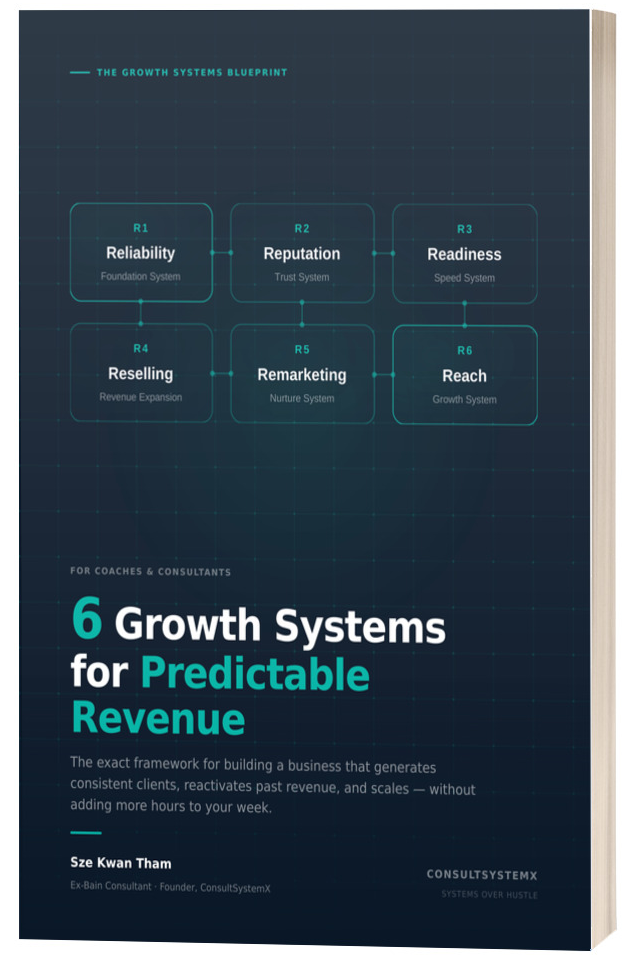
If you want the full map of what sits behind consistent clients, the free D6R Growth Blueprint lays out all six pieces in the order to build them.
It covers Reputation and Reach in depth, along with the four pieces that turn attention into clients and keep them, each with a self-assessment and a 90-day roadmap for putting it in place. Get the free D6R Growth Blueprint.
Frequently Asked Questions
How do I get high-ticket coaching clients?
You get high-ticket coaching clients by going where buyers who can afford you already gather, and by giving them evidence before the first call. Referral partners who serve established businesses, podcasts aimed at your buyer, and specific testimonials do more than volume does. A bigger decision also takes longer, so high-ticket work needs patient, well-spaced follow-up.
What is the fastest way to get clients?
The fastest way to get clients is to contact people who already know you: past clients, old inquiries and referrals that never turned into work. They don't need convincing that you're good, only a well-timed reason to talk again. A short, specific note to that list is quicker than building any new channel.
How do coaches get clients without social media?
Coaches get clients without social media through past clients, referral partners, podcast guesting, workshops and talks, articles that rank in search, and an email list. These channels borrow trust from someone else or build it in places you own. They're slower to show feedback than social platforms, but they don't depend on an algorithm.
Why do referrals stop working?
Referrals stop working because they depend on other people's timing and memory, and your network is a fixed pool that empties as the people who needed you hire you. Referrals still matter. They work best as one source among two or three, with a deliberate ask built into your delivery, rather than the only way clients find you.