
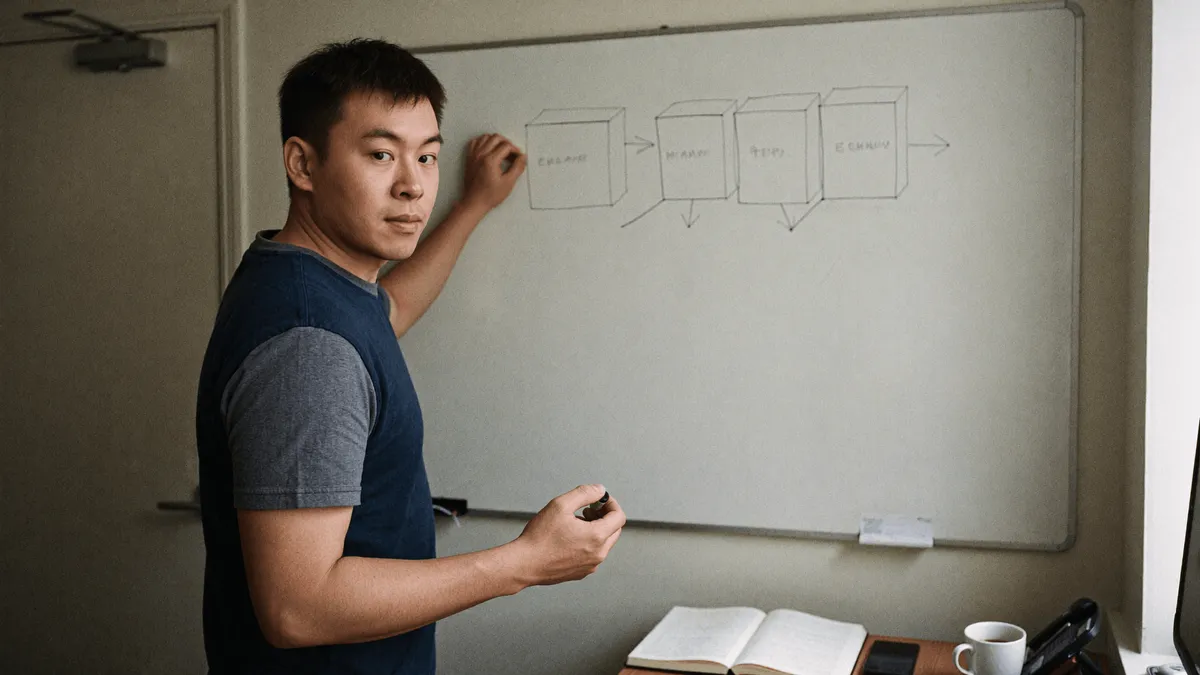
Client Acquisition System for Coaches and Consultants
"I don't know where my next client is coming from."
If you've said that even once, even quietly, you're not alone. Coaches and consultants earning $2K–$10K a month say it constantly. And most of them have tried things — a new LinkedIn strategy, an email campaign, a referral push, a webinar. Some work for a few weeks. None of them stick.
That's the tell. When effort is high and results are random, the problem isn't the effort. It's that nothing connects.
I spent years at Bain advising large companies on exactly this — operational systems, growth infrastructure, the unglamorous architecture that makes output predictable. Then I started my own consulting practice and built it the way everyone else does: on my own memory, my own hours, and whichever tactic looked promising that quarter. It grew to a reasonable size and stopped, because I had become the bottleneck in my own business.
At one point I spent $11,000 on ads and could trace $2,400 in revenue back to it. The ads weren't the problem. There was nothing behind them to catch what they sent.
This is the whole system, in the order it should be built, and the diagnostic to find which part of it you're missing.
What Is A Client Acquisition System?
The Misdiagnosis That Keeps Practices Stuck
The D6R Framework: The Right Build Order
R2 — Reputation; Review Multiplication & Reactivation Engine System
R3 — Readiness; The Missed Opportunity Recapture System & AI Conversation Conversion System
R4 — Reselling; The Revenue Resurrection Engine System & Birthday Cash Machine System
R5 — Remarketing; The Stay-Top-Of-Mind System
Why almost everyone starts at R6 — Reach
The Diagnostic: Which Pillar Is Costing You Most
How long does it take to build?
Build It Yourself, Or Have It Built
What is a client acquisition system?
How is a client acquisition system different from a strategy?
How long does it take to build one?
Key Takeaways
A client acquisition system is infrastructure, not a campaign. It's the connected set of processes that turns a stranger into a client without depending on you remembering to act.
Six parts, and the sequence is the point: Reliability, Reputation, Readiness, Reselling, Remarketing, Reach.
Almost everyone builds the last one first. Driving traffic into a business with no system behind it amplifies the leaks, not the strengths.
Most coaches and consultants aren't at the beginning. They're at the stage where the tools got bought, and nothing got connected.
You don't need all six this quarter. You need to know which one is costing you the most right now.
Where To Start, By Stage
You don't build six systems at once. Build in this order and stop when you've fixed the leak that's actually costing you clients.
D6R Pillar | What Sits Here | Build It When | Effort | Time to Traction |
|---|---|---|---|---|
Reliability | Delivery you can repeat | First, at every stage | Medium | 4-8 weeks |
Reputation | Review and referral infrastructure | $2K-$5K/month | Low | 2-4 weeks |
Readiness | Instant response and qualification | $5K-$10K+/month | Medium | 2-6 weeks |
Reselling | Renewals, upsells, reactivation | Once you have past clients | Low | 1-3 weeks |
Remarketing | Nurture for prospects who aren't ready | With a list or following | Medium | 4-8 weeks |
Reach | Website, lead capture, campaigns | Once pillar 1-5 are solid | High | 8-16 weeks |
If you're in Hustle ($2K–$5K/month): Reliability and Reputation. Get delivery consistent and referrals arriving deliberately rather than by luck. Don't run ads yet.
If you're in Tools & Chaos ($5K–$10K/month): add Readiness and Reselling. Automate the first response, and build a structured path to renewals.
If you're ready for Systems & Scale ($10K+/month): layer in Remarketing and Reach. Now paid and organic acquisition amplifies infrastructure that already works.
What Is A Client Acquisition System?
A client acquisition system is the connected set of processes that takes someone from first hearing about you to becoming a paying client — and runs whether or not you're available that week.
The word doing the work is connected. Most practices have the pieces in some form: a website, a booking link, an email list, a testimonial or two, a follow-up habit. What they don't have is anything joining them. The website doesn't tell the CRM. The CRM doesn't trigger the follow-up. The follow-up happens when you remember.

A system is what you have when each step hands off to the next without you carrying it across.
How it differs from a strategy. A strategy decides what to do — which market, which offer, which channel. A system is the machinery that executes that decision every time, at the same standard, on your busiest week as well as your quietest. Strategy sits in a document. A system runs in the background. Strategy without a system is where inconsistent months come from.
The Misdiagnosis That Keeps Practices Stuck
There's a belief almost every coach and consultant holds at some point: if I just get better at marketing, everything will scale.
It isn't wrong exactly. It's incomplete. Better marketing without better systems doesn't create growth. It creates chaos at higher volume.
Here's the mechanism. Every tactic you add creates work that lands on you — a lead to answer, a comment to reply to, a proposal to chase. Add a channel, and you add throughput to a process whose only capacity is your attention. Past a certain point, adding tactics makes the business worse, because the leaks scale with the volume.
Which is why the honest version of "I need more leads" is usually "I need to stop losing the ones I already get."
It's not a leads problem. It's a sequence problem.
Which Stage Are You In?
Stage | What It Looks Like | What's Missing |
|---|---|---|
Stage 1: Hustle | Everything manual. Revenue comes from effort, not structure. | Any system at all |
Stage 2: Tools and Chaos | Tools bought, some automation, nothing talks to anything. Busier, not lighter. | A framework connecting the tools |
Stage 3: Systems and Scale | Predictable, largely automated, doesn't collapse when you step away | This is the target |
Almost everyone reading this is in Stage 2. That matters, because Stage 2 isn't a knowledge problem. You already knew you needed systems — you went and bought some. What's missing is the connective work, and no additional tool fixes that.
The D6R Framework: The Right Build Order
Six parts. Each assumes the one before it exists. This is the D6R DOMINATE System™, and the sequence is the point of it.
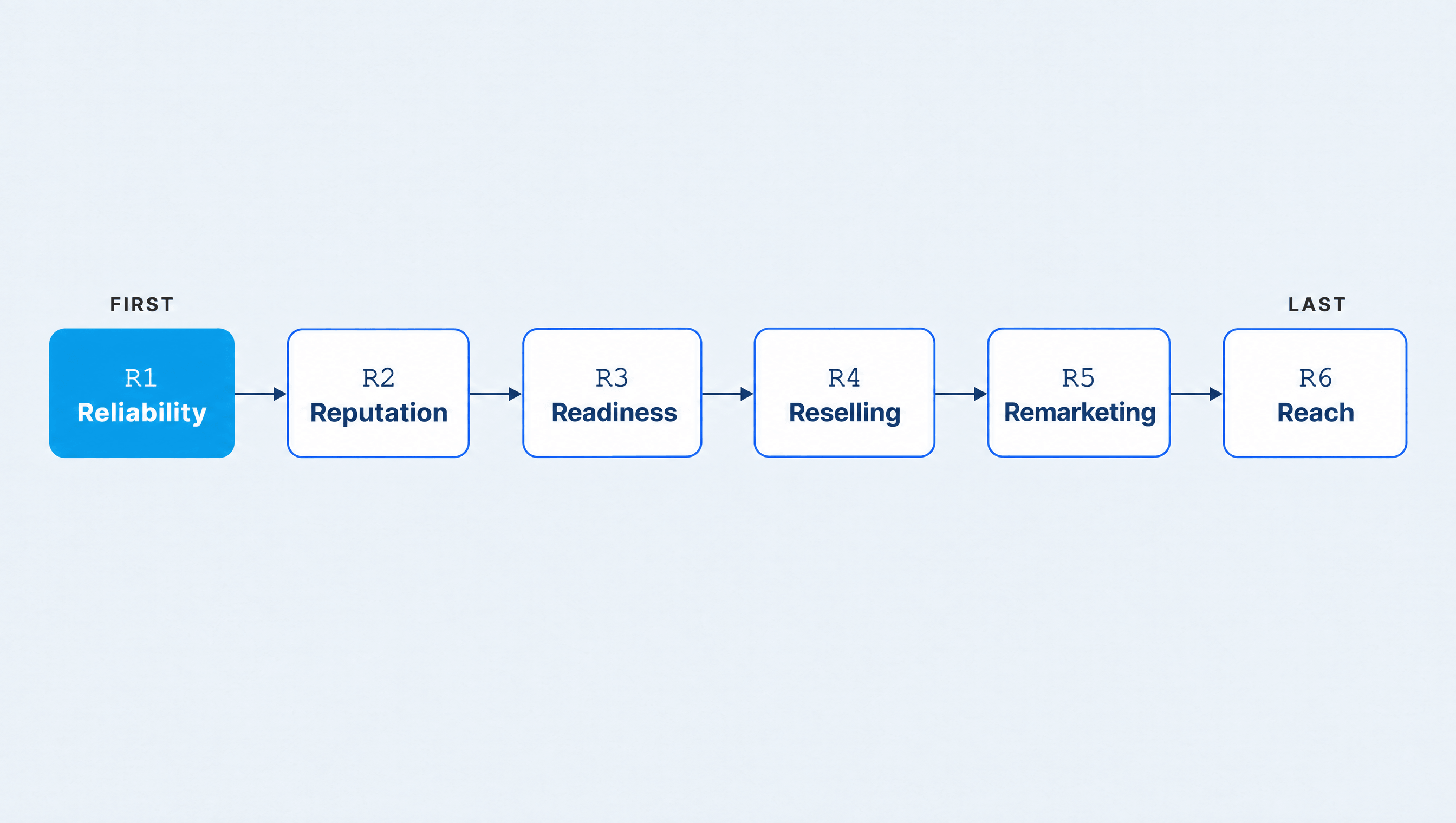
R1 — Reliability
What it is: delivery you can repeat. A documented process, the same client experience every time, nothing that only works because you happened to be free that week.
This comes first because everything that follows amplifies whatever is already here. Reputation is easier when delivery is consistent. Reselling is possible when the first engagement went well. If delivery depends on your personal attention, every system built on top of it inherits that ceiling.
Most people skip this because it isn't marketing. It's the most expensive skip in the sequence.
Start by mapping your delivery end-to-end and writing down every step that currently lives only in your head.
R2 — Reputation; Review Multiplication & Reactivation Engine System
What it is: what a prospect finds when they search your name, built deliberately rather than by accident.
Before anyone speaks to you, they've already looked. That takes under two minutes, and you're not in the room for it. The Review Multiplication & Reactivation Engine System (Reputation) handles the part you can control: asking for reviews at the point in the engagement where satisfaction is highest, monitoring the platforms you don't own, and making sure every review gets a response rather than just the ones you noticed.
Good work does not reliably produce reviews. Satisfied clients are busy. Dissatisfied ones are motivated. If you're not sure when or how to ask clients for testimonials, I've written out the timing and the scripts separately.
Referrals live here too, and the same principle applies: most practices wait for them rather than engineering them. Build a specific referral moment into your delivery process — the best time to ask is at a client's first visible win, not at the end of the engagement when the memory has cooled. If referrals and your network are running dry, here's how to get coaching clients consistently without waiting on the next introduction.
R3 — Readiness; The Missed Opportunity Recapture System & AI Conversation Conversion System
What it is: how fast and how cleanly an interested person becomes a booked call.
This is where most pipelines actually leak. When Conversica submitted sales inquiries to 100 mid-market and enterprise companies in 2023 and tracked what happened over 22 days, one in four never responded at all, and around 35% made only one or two contact attempts. That's the standard you're measured against, and it's low. Closing that gap is the job of lead follow-up, a discipline in its own right.
Two systems carry this. The Missed Opportunity Recapture System (Readiness) fires an automated text the moment a call goes unanswered, so a missed call doesn't quietly become a lost client. The AI Conversation Conversion System (Readiness) answers, qualifies, and books across your website and social channels around the clock — including the inquiry that arrives while you're mid-session.
Removing the wait entirely beats responding faster. In Chili Piper's 2025 benchmark report, drawn from nearly 4 million form submissions across its B2B customer base, 66.7% of qualified form submissions booked a meeting when the prospect could book on the form itself, against roughly 30% where booking required follow-up afterwards. That sample is their own customers, so treat it as directional — but the direction is clear.
The first automated lead I received came in at 2:34 in the morning. By the time I woke, it had been acknowledged, qualified, and booked onto my calendar. I hadn't touched it. That was the moment this stopped being theoretical for me.

R4 — Reselling; The Revenue Resurrection Engine System & Birthday Cash Machine System
What it is: revenue from people who have already bought, which is the cheapest revenue available to you.
The Revenue Resurrection Engine System (Reselling) runs structured reactivation across past clients and inquiries that never converted — people who already know you and need a reason, not an introduction. The Birthday Cash Machine System (Reselling) does the same on a predictable annual trigger.
The practical version: have a defined upgrade path, a renewal conversation and a retainer offer ready before you close the next client, not improvised afterwards. Most practices treat a finished engagement as a finished relationship. It's the largest unworked asset in a typical consulting business.
R5 — Remarketing; The Stay-Top-Of-Mind System
What it is: staying present with people who aren't ready yet, without pitching them every time.
"Not now" becomes "never" when the only contact a prospect has with you is a sales message. The Stay-Top-Of-Mind System (Remarketing) keeps prospects engaged through the gap between interest and readiness — which in this market is routinely months, not days.
This layer sits between Reselling and Reach for a reason: a warm audience converts far more easily than cold traffic, and proving your conversion there first makes the eventual spend on Reach more efficient.
R6 — Reach; The Client Generation Website Machine System, Client Catalyst System and Welcome Mat Lead Vacuum System
What it is: visibility. New audiences, new traffic, paid and organic.
Three systems sit here. The Client Generation Website Machine System (Reach) makes your site a lead-generation asset rather than a brochure: who you serve and what outcome you deliver, capture that works on cold visitors rather than only referrals who already trust you, and proof that builds confidence before a discovery call. The Welcome Mat Lead Vacuum System (Reach) turns visitors into opted-in leads at the first touchpoint. The Client Catalyst System (Reach) runs targeted campaigns to fill the pipeline with prospects who fit.
Reach is last for a reason, and that reason is most of this article.
Why almost everyone starts at R6 — Reach
Reach is the only one of the six that feels like marketing. It's also the only one you can buy on a Tuesday afternoon. So it's where people start.
Run visibility into a business without the other five and here's what happens: traffic arrives, some of it inquires, those inquiries wait because you were with a client, a few book, the rest go quiet because nothing follows up, and the ones who don't buy this month are never contacted again.
Then the conclusion: ads don't work for my business.
The ads worked. They delivered people to a process that couldn't hold them. My $11,000 bought exactly that lesson.
Building Reach last isn't patience for its own sake. It's that every dollar of visibility is worth more once there's something behind it.
The Diagnostic: Which Pillar Is Costing You Most
Answer honestly rather than aspirationally — how it works on your busiest week, not your best one.
Reliability
If you took two weeks off, which parts of client delivery would stop entirely?
Is your delivery process documented anywhere outside your head?
Does every client get the same experience, or does it depend on how busy you were?
Reputation
Search your own name and business name right now. Is what a prospect finds in the first two pages deliberate, or whatever accumulated?
Do clients leave reviews as a natural part of working with you, or only when you remember to ask?
Can you name your top five referral sources without looking?
Readiness
When an inquiry arrives while you're in a session, what happens today? Not in theory — today.
Is there a qualification step before a stranger can take a slot on your calendar?
Can someone book you without a back-and-forth email exchange?
Reselling
When did a past client last hear from you about something other than an invoice?
Do you have an upsell or retainer offer defined before you close a new client?
Do you know the average lifetime value of a client you sign?
Remarketing
Of everyone who inquired in the last six months and didn't buy, how many have heard from you since?
Is there a sequence for subscribers who never booked?
Reach
Can you name where your last five clients came from, and repeat it on purpose?
Is there at least one lead magnet actively generating subscribers?
How to read your answers. Two or more "no" answers in a section means that pillar is a real gap. If several sections fail — which is normal, not a sign something is broken — start at the earliest pillar you failed, not the most interesting one. The ones downstream inherit the problem.
How long does it take to build?
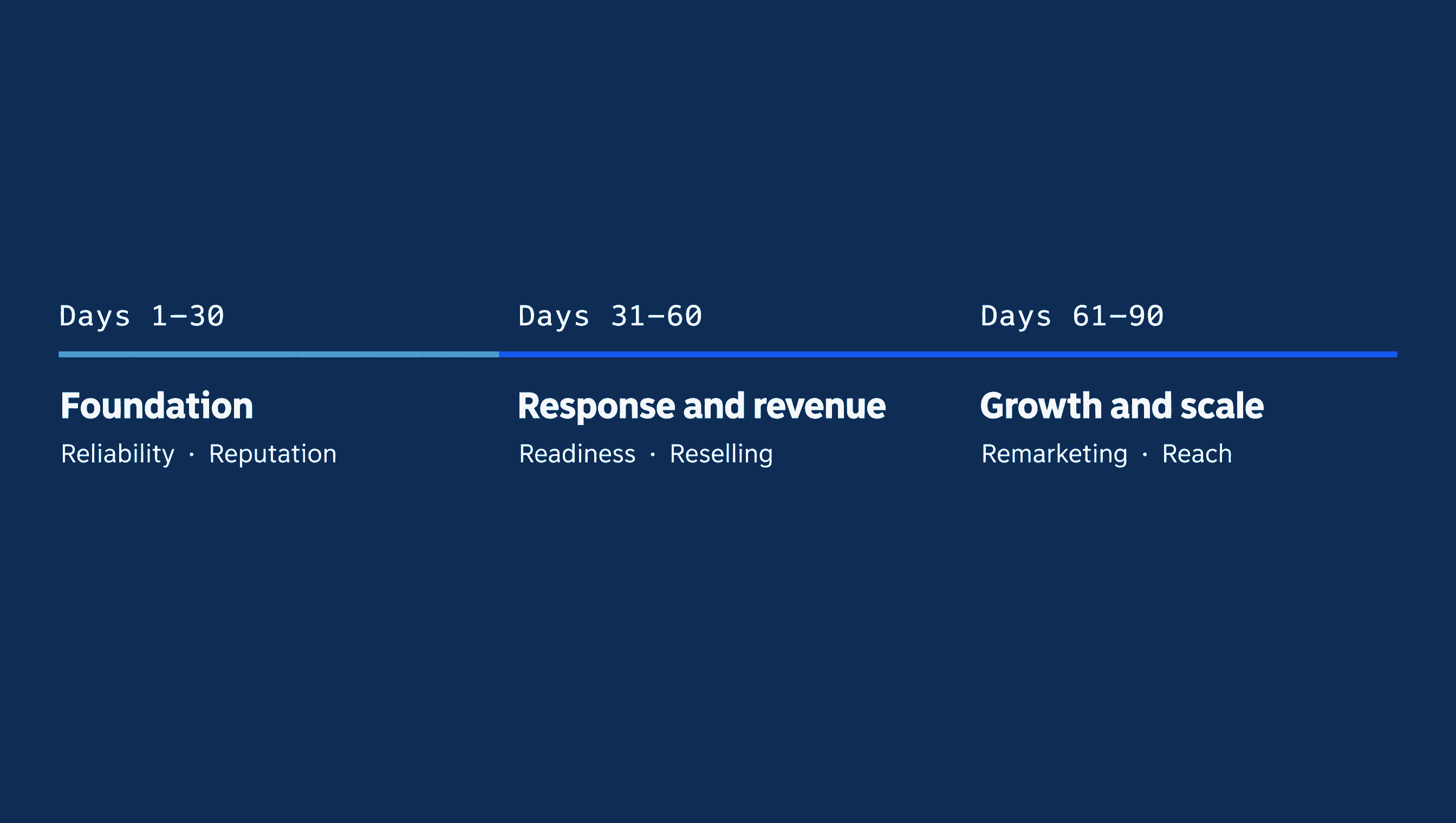
Roughly a quarter for all six, built in sequence.
Days 1–30 — Foundation. Reliability and Reputation. Map and document delivery, audit what prospects find when they search you, launch systematic review requests.
Days 31–60 — Response and revenue. Readiness and Reselling. Consolidate every channel into one inbox, add automated acknowledgment and after-hours coverage, then build reactivation for past clients and unconverted inquiries.
Days 61–90 — Growth and scale. Remarketing and Reach. Nurture sequences for prospects who aren't ready, then the website, lead capture and campaigns.
Done for you, a full build typically runs 8–16 weeks. Built yourself, around a full client load, expect 6–12 months — the difference is rarely capability, it's the hours left after delivery. Either way you'll see returns before the whole thing is finished: Readiness usually pays back first, because it stops losses rather than creating new demand.
The discipline that makes this work is finishing each phase before starting the next. Jumping ahead to Reach because it feels more urgent is the single most common reason the spend on Reach disappoints.
Build It Yourself, Or Have It Built
Both are legitimate. The question is which constraint binds you.
Doing it yourself means learning the platforms, writing the copy, configuring the automations, and working the sequence without a diagnostic baseline. It's slower, and it's frequently abandoned at the first integration problem — not from lack of ability, but because delivery work always wins the calendar.
Having it built covers the six pillars in sequence: the copy and technical configuration, the positioning and messaging underneath it, ongoing optimization as data arrives, and an accountability structure that keeps the build moving when a client project lands on you.
One honest note on choosing: if you don't yet have a validated offer and consistent delivery, neither. Sell first. Systems amplify what already works; they don't create demand for something that isn't landing.
Frequently Asked Questions
What is client acquisition?
Client acquisition is the complete process of turning someone who has never heard of you into a paying client — attracting them, earning enough trust to start a conversation, converting it, and doing it repeatably. For a service business, it covers everything from visibility through delivery, not just the marketing at the front.
What is a client acquisition system?
It's that process built as connected infrastructure rather than separate activities. Each step hands off to the next automatically, so an inquiry is acknowledged, qualified, followed up and booked without depending on you remembering. Six pillars: Reliability, Reputation, Readiness, Reselling, Remarketing and Reach.
How is a client acquisition system different from a strategy?
A strategy decides what to do — which market, which offer, which channels. A system executes that decision the same way every time, whether you're delivering a project, on vacation, or having a slow week. Strategy sits in a document. A system runs in the background.
How long does it take to build one?
About 90 days for all six in sequence — roughly 30 days each for the foundation, the response and revenue layer, and the growth layer. Done for you that's typically 8–16 weeks; built yourself around a full client load, 6–12 months. Individual pillars pay back sooner, and Readiness usually shows up first.
Where do most coaches and consultants go wrong?
They start with Reach. Ads, daily content, or hiring someone to generate leads — before the website converts, before follow-up is automated, before there's a resell path. The traffic arrives and finds nothing built to hold it. Building conversion capability before driving traffic is the entire argument of the sequence.
About the author. SK Tham spent years at Bain & Company advising large organizations on growth strategy and operational systems before founding ConsultSystemX, which builds done-for-you growth systems for coaches, consultants, and boutique firms. ConsultSystemX runs its own business on the same six systems it installs for clients.
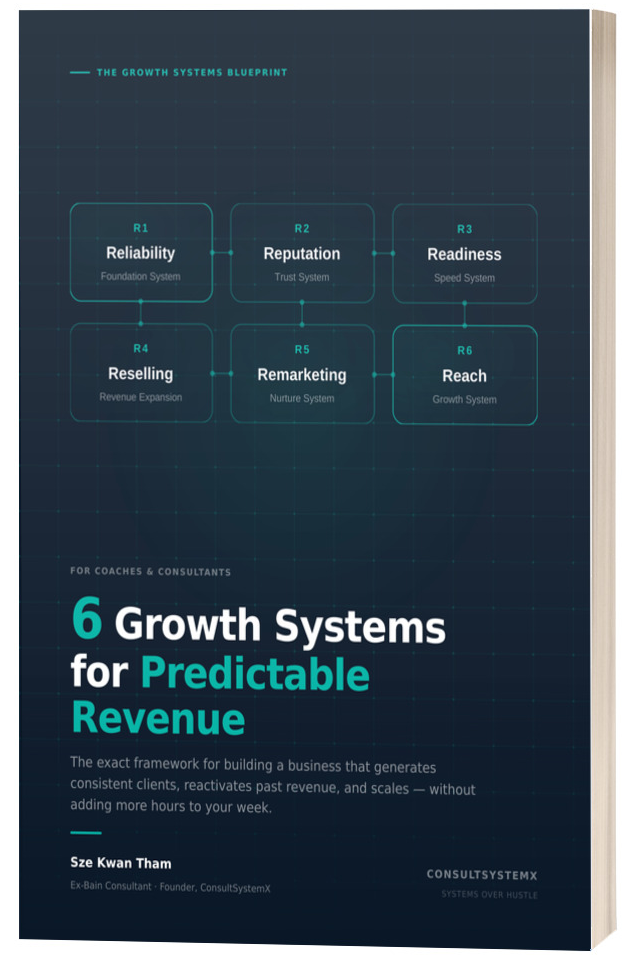
If you want the full version — each pillar explained in depth, a self-assessment for each one, and the 90-day implementation roadmap — it's all in the free D6R Growth Blueprint.
Written for emerging coaches and consultants ($2K–$10K/month), established coaches and consultants ($10K+/month), and boutique consulting firms of 1–10 people with a validated offer.
Sources
Conversica (2023). Sales Effectiveness Report: inbound lead follow-up across 100 mid-market and enterprise companies, tracked over 22 days. https://www.businesswire.com/news/home/20230504005428/en/Research-Finds-Half-of-Companies-Are-Failing-Buyers-and-Losing-Revenue-Due-to-Poor-Lead-Follow-Up
Chili Piper (2025). Form Conversion Rate Benchmark Report: nearly 4 million form submissions across its B2B customer base, 2024 data. https://www.chilipiper.com/post/form-conversion-rate-benchmark-report