

Follow-Up Email After No Response: 7 Templates
"I'm terrible at following up."
I hear some version of that from coaches and consultants more often than any other confession about their sales process. Not "my calls go badly." Not "my offer is wrong." Just a quiet admission that the emails they meant to send never got sent, and the prospects they meant to chase stopped being prospects.
The frustrating part is that following up isn't hard. It's forgettable. There's no calendar entry for the proposal you sent eleven days ago, no alert when someone reads your recap and doesn't reply. By the time you remember, enough time has passed that reaching out feels awkward.
This article gives you seven emails for the moments that decide whether a good conversation becomes a client, with the timing for each and why it works. These are for prospects and clients — if you're chasing a job application, this isn't the right page.
Each template on its own is a patch. The structure underneath them is the full lead follow-up system, and it's worth reading once you've got the words sorted.
Quick-start: which template you need first
What to say instead of "just checking in"
2. The inquiry that went quiet
3. After you sent the proposal
5. When the proposal is still silent
6. The "still a priority, or parked?" check-in
How many follow-up emails is too many
Putting the sequence on autopilot
How long should you wait before following up?
How do you politely say "just following up"?
How many follow-up emails is too many?
What should a final follow-up email say?
Key Takeaways
Silence is rarely a decision. It's usually the absence of one, and a good follow-up makes deciding easy rather than applying pressure.
The first follow-up does most of the work. In an analysis of 12 million outreach emails, adding a single follow-up raised reply rates by 65.8%. Almost nobody sends it.
Most of your competition is doing nothing. When researchers sent inquiries to 100 companies, one in four never replied and around 35% gave up after one or two attempts.
Timing follows the moment, not a rule. Three days after a proposal is patient. Three days after a no-show is late.
"Just checking in" fails because it asks the reader to work out what you want. Give them a two-choice question instead — it makes saying no easy, which is what unlocks the replies.
Templates fix the words, not the forgetting. That needs a trigger, not more willpower.
Quick-start: which template you need first
Don't build all seven. Find the moment where silence costs you most, and fix that one.
Template | Trigger | Best For | Send Window | The goal |
|---|---|---|---|---|
1 | After a discovery call | Coaches with a full call calendar | Recap same day, follow-up day 3 | Surface the real decision-maker |
2 | Inquiry that went quiet | Anyone taking web or DM inquiries | 2 business days after you reply | Qualify with one binary question |
3 | After sending a proposal | Consultants with project fees | Day 3 | Get a yes or a clean no |
4 | No-show on a booked call | Anyone | Within 2 hours | Re-book without awkwardness |
5 | Proposal still silent | Consultants | Day 10-12 | Add something new, reopen it |
6 | "Not now" or parked | Anyone with a long sales cycle | 30 days, then quarterly | Stay visible without chasing |
7 | Nothing after three attempts | Anyone | Day 21-30 | Exit cleanly, keep the relationship |
Start here if you are:
A coach running discovery calls — template 1, then template 5 if it stays quiet.
A consultant sending proposals — template 3, then 5, then 7.
Getting leads from a website form — template 2 is the highest-value email you'll send this week.
Why they didn't reply
Most silence after a good conversation is a scheduling problem, not a verdict. Your proposal landed on the day their biggest client escalated something. They meant to reply that evening. Then it slid out of view, and now replying late feels rude, so they don't reply at all.

There's a second reason worth internalizing: people avoid sending bad news. A prospect who has decided against you often finds it easier to say nothing than to write "we've decided to go another way." Their silence isn't about you.
Both problems have the same fix. Make replying cheap. Ask something answerable in four words. Give explicit permission to decline.
And the bar is low. When Conversica submitted inquiries to 100 mid-market and enterprise companies and tracked what happened over 22 days, one in four never responded at all, and around 35% made only one or two attempts before giving up. Most of your competitors are not out-following-up you. They are doing nothing.
The coaches who struggle most with follow-up are usually the ones most serious about the work — they don't want to feel like a salesperson. The reframe that helps: follow-up is client service before the contract is signed. It shows a prospect how you'll communicate once they're paying you.
What to say instead of "just checking in"
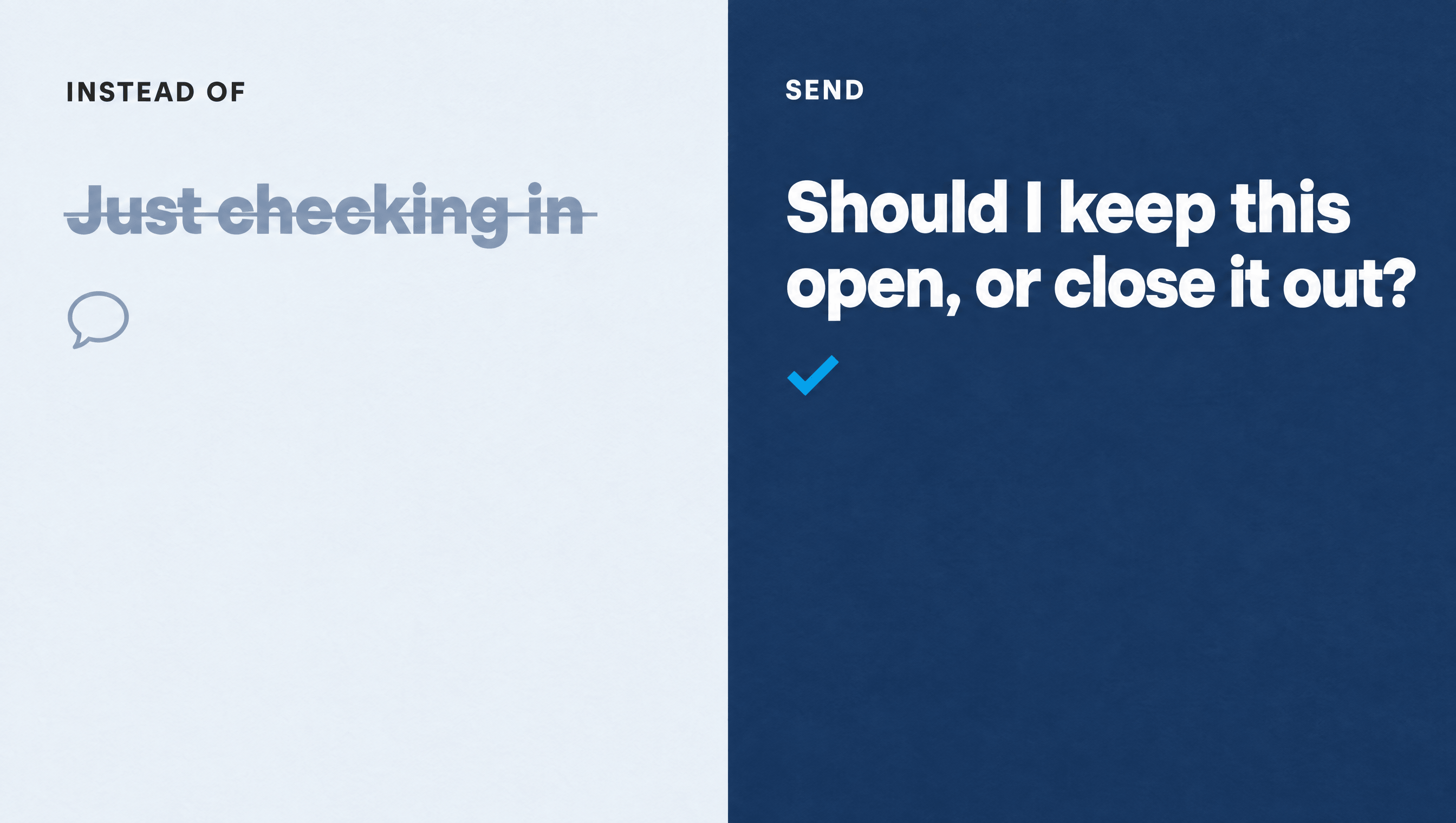
"Just checking in" fails because it puts the work on the recipient. They have to reconstruct the context, guess what you want, and decide how much effort a reply deserves. The fix isn't a better phrase; it's carrying a specific question.
Instead of | Send | Use it when |
|---|---|---|
"Just checking in" | "Is [A] or [B] the priority right now?" | First follow-up, you need to qualify |
"Following up on my last email" | "Should I keep this open, or close it out?" | Second or third touch on a proposal |
"Any update on this?" | "Who else needs to sign off before this moves?" | A call went well and then stalled |
"Wanted to bump this up your inbox" | "Saw [relevant thing] and thought of your [challenge]" | You have something genuinely useful to send |
"Let me know your thoughts" | "Does Thursday at 2 work, or is next week better?" | You want a booking, not a discussion |
"Circling back" | "Timing wrong? Happy to check back in [month]." | Closing the loop without closing the door |
Each replacement has the same two properties: it can be answered in one line, and it makes clear what happens next.
One rule about threads. Reply inside the original thread for your first follow-up — the context is right there. For the second or third attempt, start a fresh email with a new subject line. A thread already ignored twice rarely gets opened on the third reply.
The 7 templates
Use these as starting points, not scripts. The specifics — their goal, their obstacle, the number you discussed — stop a template from reading like one.
And pick one tone, then keep it across every message: direct, warm, or formal. Mixing tones is what makes automated follow-up feel robotic; consistency is what makes it feel intentional.
1. After a discovery call
When: Three business days after your post-call recap goes unanswered.
Subject: Re: [original recap subject]
Hi [First Name],
No pressure on the recap I sent — these decisions rarely happen in a week.
One thing I should have asked on the call: who else needs to be comfortable with this before it moves? If it helps, I'm happy to put together a short version you can forward.
And if the timing has shifted, that's completely fine — tell me and I'll check back in [month] instead.
[Your name]
Why it works: It surfaces the real blocker in most stalled deals — a second decision-maker you never met — and hands them a graceful way to defer rather than disappear. Going quiet after a good call is common enough to have its own patterns, which I've written about separately for prospects who ghost after a call.
2. The inquiry that went quiet
When: Two business days after you replied to their form or DM and heard nothing back.
Subject: Quick question about [their stated goal]
Hi [First Name],
You reached out about [what they asked for] — I replied on [day], but inboxes are brutal, so I'm bumping this up.
One question so I don't waste your time: is [challenge A] or [challenge B] the thing you're trying to fix first?
If you've sorted it elsewhere, just say so and I'll close the file.
[Your name]
Why it works: It gives a reason that isn't about you, asks a binary question, and offers an exit. All three lower the cost of replying.
An inquiry already sitting in the pile deserves the shortest patience of anything here. Harvard Business Review's analysis of online lead response found firms replying within an hour were roughly seven times more likely to have a meaningful qualifying conversation than those waiting an hour longer.
3. After you sent the proposal
When: Three business days after sending.
Subject: [Project name] — proceed or park?
Hi [First Name],
Following up on the proposal I sent Tuesday.
Simple either/or so you don't have to write a long reply: do you want to move ahead as scoped, or should we park this for now?
Either answer is genuinely useful to me. "Park it" means I stop taking up space in your inbox.
[Your name]
Why it works: The two-choice question is the most effective device in this article. It makes "no" socially acceptable, which is what unlocks the replies you'd otherwise never get.
4. After a no-show
When: Within two hours of the missed call.
Subject: I held the time — want to grab another?
Hi [First Name],
I was online for our call at [time] and wanted to check in, in case something came up. Happens to all of us.
Here's my calendar if you'd like to grab another slot: [link]
And if the timing's wrong right now, that's completely fine — just say so and I'll stop chasing.
[Your name]
Why it works: Most no-shows aren't rejections — something more urgent landed between booking and the call, which is especially common when the call was booked more than a week out. "Happens to all of us" removes the embarrassment that otherwise stops a no-show ever writing back. One click to rebook does the rest.

5. When the proposal is still silent
When: Day 10–12 after the original proposal.
Subject: One thing I wanted to add
Hi [First Name],
Following up on the proposal — since I put it together, I had a thought that might be useful.
[One concrete addition: a relevant worked example, a timeline consideration, or a question that reframes the decision.]
Not chasing. Still happy to walk through anything if it helps. [Booking link.]
[Your name]
Why it works: Every follow-up after the first needs to carry something new. Repeating the proposal makes a prospect less interested, because it signals you have nothing to add. Send one of these, not four.
6. The "still a priority, or parked?" check-in
When: 30 days after they said "not right now."
Subject: Still on the radar?
Hi [First Name],
Checking in on [project] — still a priority this quarter, or has it been parked?
Either way, [resource] might be useful: [link].
If it's parked, want me to check back in [timeframe]?
[Your name]
Why it works: "Not now" is a timing problem, not a rejection, and this treats it that way. Asking permission to follow up again turns what would feel like pestering into something they agreed to.
7. The close-the-loop email
When: Day 21–30 after your last contact, once three attempts have gone unanswered.
Subject: Closing the loop
Hi [First Name],
I've reached out a few times and haven't heard back, which usually means the timing isn't right or priorities moved. Either is completely fair.
I'll stop here so I'm not cluttering your inbox. If anything changes, you know where to find me.
Wishing you well either way — and I hope [specific goal they mentioned] works out.
[Your name]
Why it works: Counterintuitively, this often gets the highest reply rate of any message in a sequence. Removing the pressure is what prompts the person who meant to reply weeks ago to finally do it. And when it doesn't, you've ended the thread with your reputation intact. Resist the urge to add "did I say something wrong?" — that only puts social pressure on the reader.
How many follow-up emails is too many
The number matters less than whether each message carries something new. Four emails that each add a thought are easier to receive than two that say "just following up."
That said, persistence is real. Velocify's analysis of roughly 3.5 million leads found that 93% of leads that eventually converted were reached by the sixth contact attempt. Those were call attempts rather than emails, so treat it as a signal about persistence in general rather than a precise email number. The direction is what counts: most people stop several touches before the point where the remaining conversions happen.
The clearest evidence on email specifically comes from Backlinko and Pitchbox's study of 12 million outreach emails, which found that adding a single follow-up raised reply rates by 65.8%. That was cold link-building outreach rather than warm prospects who already spoke with you, so it's directional rather than a forecast for your pipeline. But the shape holds: the second email does a disproportionate amount of the work, and almost nobody sends it.
For a warm prospect, three or four emails across two to three weeks, then a close-the-loop email, is a sensible ceiling.
Putting the sequence on autopilot
None of this survives contact with a busy week unless something other than your memory triggers it. That's the actual failure. It isn't that coaches don't know to follow up; it's that following up competes with delivery, and delivery always wins.
I learned this the expensive way. Early on I lost a $22K-a-month client — not because the work was bad, but because I'd become the bottleneck in my own business. Anything without a deadline attached quietly stopped happening.
The fix is to attach each message to an event rather than an intention:
Trigger — a form submission, a booked call, a completed call, or a sent proposal.
First email — fires immediately or same day, depending on the trigger.
Wait 3 days — if no reply, send the follow-up for that moment.
Wait 7 days — if still nothing, send the second touch with something new in it.
Wait 7 more days — send the close-the-loop email. Sequence ends.
Exit condition — any reply removes them from the sequence immediately.
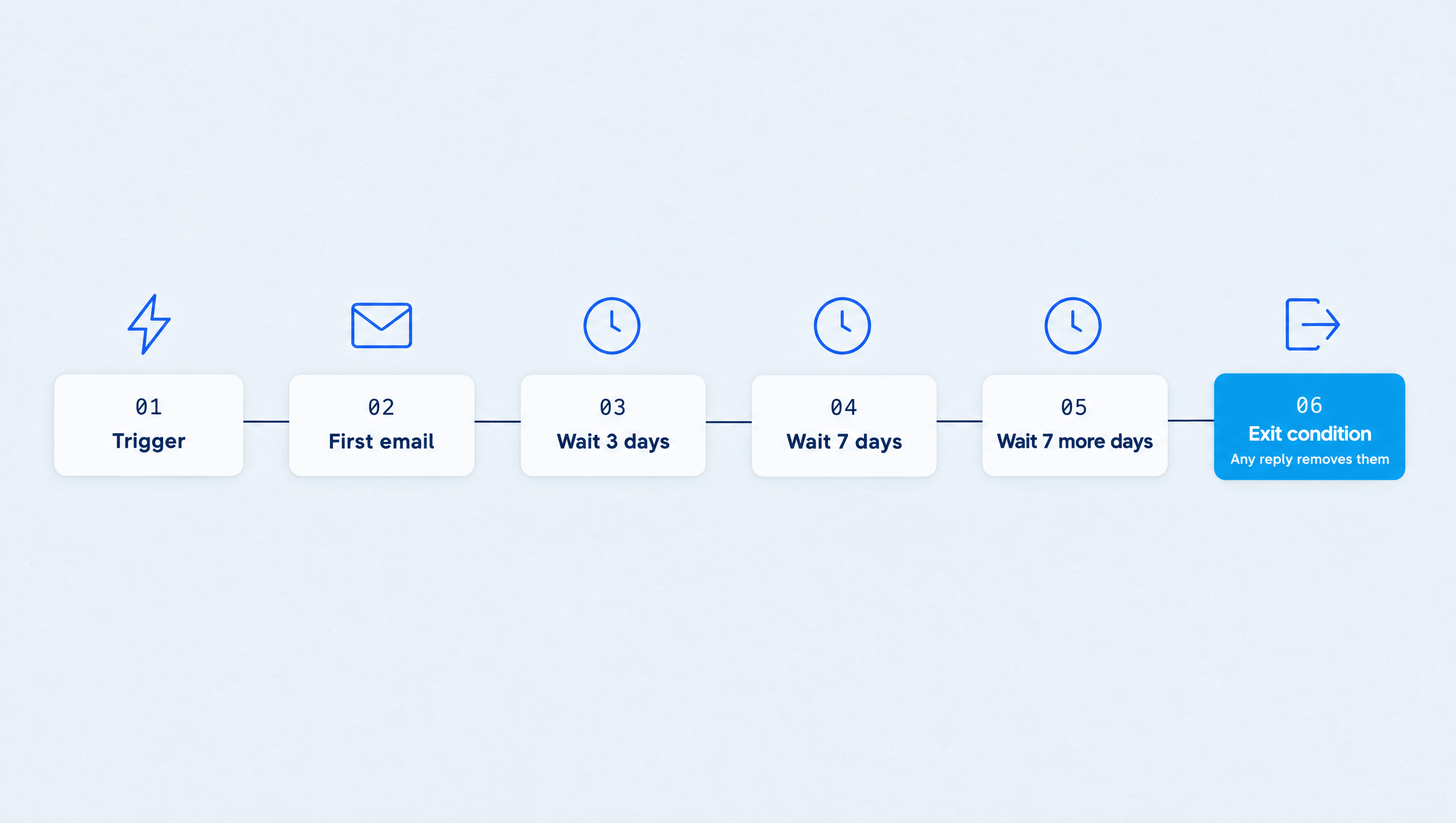
That last line matters most. An automated email arriving after a prospect has already replied is worse than no sequence at all, because it tells them the warmth was fake. Set the exit condition before anything else.
In the framework I use, staying visible with people who aren't ready yet is the Remarketing habit — the one most practices skip, because it produces nothing this month and stays invisible until a prospect resurfaces six months later, already warm.
Two things to protect when you automate. Keep the post-call recap written by hand — it's the message that decides the deal, and it needs details only you heard. And set an alert for replies, so a human picks up the thread the same day.
Start here
Write one message properly, attach it to its trigger, and leave the other six for later. One automated moment beats seven you meant to get around to.
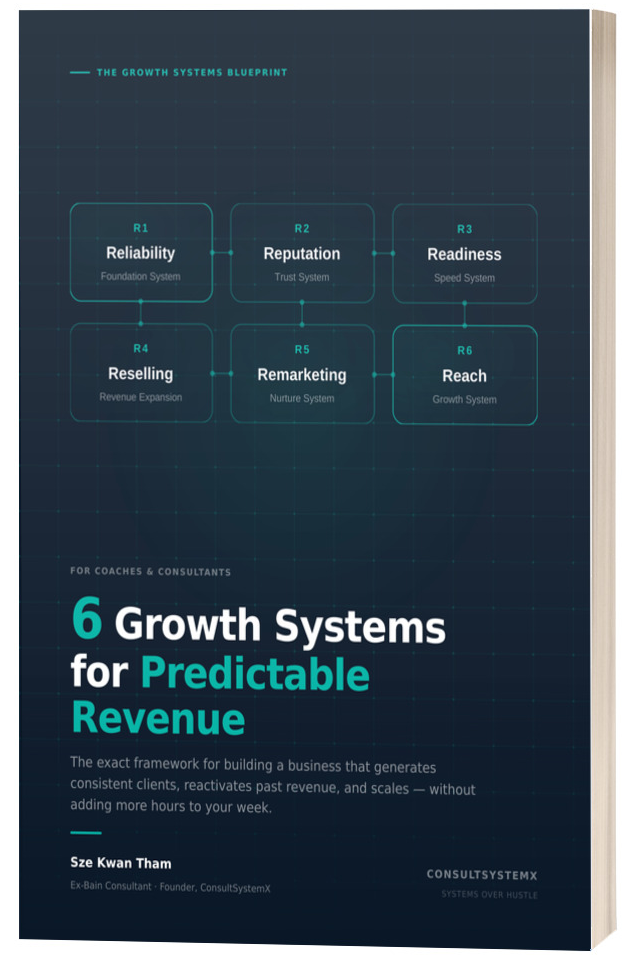
If you want the structure these templates sit inside — the six systems behind predictable revenue, with a self-assessment for each and a 90-day implementation order — that's what the D6R Growth Blueprint covers. It's free, about 40 pages, and written for coaches and consultants who already have something working and want it to stop depending on them.
Get the free D6R Growth Blueprint →
Frequently asked questions
How long should you wait before following up?
It depends on the moment. Two business days after an unanswered reply to an inquiry, three after a proposal, same day after a discovery call, and within two hours of a no-show. The general rule is to follow up while they still remember the conversation clearly — which is sooner than most people feel comfortable with.
How do you politely say "just following up"?
Replace it with a specific question they can answer in one line. "Should I keep this open or close it out?" is polite and useful. "Just following up" is polite and useless, because it leaves the recipient to work out what you actually want. Anchoring to a detail from your conversation is what makes an email feel personal — even when it was scheduled.
How many follow-up emails is too many?
Three to four for an active opportunity, then a close-the-loop email. After that, move the contact to a quarterly check-in. The limit isn't really a number — it's whether each message carries something the last one didn't.
What should a final follow-up email say?
It should name the silence without blame, close the thread, and leave the door open. You've reached out a few times, you're assuming the timing isn't right, you'll stop here, and they know where to find you. Removing the pressure is often what finally gets a reply — and when it doesn't, you've ended well.
Should I automate follow-up emails or send them manually?
Do both. Automate the timing and the structure so nothing falls through, and personalize the first line of each email with something specific to that prospect. The automation handles the remembering; you handle the part that has to sound like you — and you keep the post-call recap entirely by hand.
Sources
Oldroyd, McElheran and Elkington, The Short Life of Online Sales Leads, Harvard Business Review, March 2011 — firms responding within an hour were roughly 7x more likely to have a meaningful qualifying conversation than those responding an hour later, and more than 60x more likely than those waiting 24 hours or more. https://hbr.org/2011/03/the-short-life-of-online-sales-leads
Backlinko and Pitchbox, Email Outreach Study, 2019 — analysis of 12 million outreach emails; a single follow-up increased reply rates by 65.8%. https://backlinko.com/email-outreach-study
Conversica, 2023 — inquiries submitted to 100 mid-market and enterprise companies, tracked over 22 days; 1 in 4 never responded and around 35% made only one or two contact attempts. https://www.businesswire.com/news/home/20230504005428/en/Research-Finds-Half-of-Companies-Are-Failing-Buyers-and-Losing-Revenue-Due-to-Poor-Lead-Follow-Up
Velocify, The Ultimate Contact Strategy, 2016 — analysis of approximately 3.5 million leads; 93% of converted leads were reached by the sixth contact attempt. https://natlawreview.com/article/study-reveals-best-contact-strategies-optimal-lead-conversion