

Speed to Lead: What the Research Shows
"I'm losing leads because I can't respond fast enough." If you run a consulting firm of one to ten people, you've probably said a version of that. An inquiry lands at 10:15 while you're with a client. You see it at 3:30, reply with real care, and hear nothing back. There was no rejection, just silence.
Speed to lead is the name for that gap: the time between someone reaching out and getting a useful reply. It's also one of the most loosely quoted topics in sales writing. Some of the numbers you'll see trace back to real studies, and some don't trace anywhere.
This article separates the two, then turns what holds up into targets a small firm can hit while still doing client work. It sits inside the bigger picture of lead follow up: the first reply is where every follow-up sequence starts.
What does the response-time research actually show?
Which speed-to-lead numbers don't trace to a study?
Why do small consulting firms respond slowly?
What response-time targets should a small firm aim for?
What are the instant-response options?
How do you respond fast without being on your phone all day?
Get the free D6R Growth Blueprint
How quickly should you respond to leads?
How do you respond fast without being on your phone all day?
What is a good response time for a coaching or consulting business?
Key Takeaways
Speed to lead is the time from an inquiry to a useful first reply, and the clock starts when they reach out, not when you notice.
Two studies with the same lead author found that replying within the hour beats waiting longer, by a wide margin, for online inquiries.
Several widely repeated figures don't trace to any study. Plan around the ones that do.
A small firm can't reply in five minutes by hand. It can reply in five minutes with an automatic acknowledgment, then personally within the hour.
Letting people book a call on the spot removes the wait entirely, which beats replying faster.
What does speed to lead mean?
Speed to lead means the time between a prospect's first contact and your first reply that gives them a next step. The contact might be a form, a call, an email or a LinkedIn message.
Two details matter more than they look. First, the clock starts when the inquiry arrives, not when you see it. An inquiry that sits for four hours while you're in sessions has a four-hour response time, however fast you reply once you notice it.
Second, a reply only counts if it moves things forward. An auto-reply that says "we'll be in touch" stops the clock on paper and does nothing for the prospect. A reply with a booking link, an answer or a specific time for a call does.
That gives you two separate jobs. The acknowledgment confirms you received the inquiry and offers a next step, and it can go out automatically within a minute. The personal reply is you, reading what they wrote and responding to it. Most advice about speed blends the two, which is why it sounds impossible for anyone who spends the day with clients.

What does the response-time research actually show?
The research shows that replying to an online inquiry within the hour gives you much better odds of reaching and qualifying that person than replying later. Here's what each study measured, with a link to the original:
Study | What it measured | Finding | Worth knowing |
|---|---|---|---|
Lead Response Management Study, InsideSales.com and MIT, 2007 | 3 years of web leads at six companies: over 15,000 leads and 100,000 call attempts | The odds of contacting a lead dropped 100 times, and of qualifying one 21 times, between calling within 5 minutes and calling at 30 minutes | Co-published by a company that sells lead response software. It measured contact and qualification, not closed sales |
"The Short Life of Online Sales Leads", Harvard Business Review, 2011 | How quickly companies responded to web inquiries, and how that related to qualifying the lead | Firms that responded within an hour were about 7x more likely to qualify the lead than firms that waited an hour longer, and more than 60x more likely than firms that waited 24 hours or more | About online inquiries, not the hour after a discovery call. Shares a lead author with the 2007 study |
Conversica, 2023 | Inquiries sent to 100 mid-market and enterprise companies, tracked for 22 days | One in four never responded, and about 35% made only one or two attempts | Larger companies than yours, which is the point: fast, persistent replies are rare |
Form Conversion Rate Benchmark Report, Chili Piper, 2025 | About 4 million form submissions from 2024 | 66.7% of qualified submissions booked a meeting when booking happened on the form itself, against about 30% when booking needed follow-up | Drawn from the company's own B2B customers |
Velocify, 2016 | About 3.5 million leads | 93% of converted leads were reached by the sixth call attempt | Phone call attempts, not emails |
Read together, these say three things. Speed matters most in the first hour. Many businesses, including large ones, are slow or give up early, so a reliable reply stands out. And the strongest result in the table comes from removing the wait altogether: letting the person book while their interest is highest.
They also have limits. The two speed studies share an author and are about web leads in general sales settings. None of them measured a boutique consulting firm. So treat the direction as solid and the multipliers as rough. The headline result for planning purposes: 7x more likely to qualify within an hour than an hour later. The first hour is the window that matters.

Which speed-to-lead numbers don't trace to a study?
Two claims appear in most speed-to-lead articles and AI answers, and I couldn't find a study behind either one, so neither is used here.
That most buyers go with whichever company replies first. It's usually given as a precise percentage and credited to "research", with no study, sample or year attached.
That most sales need five or more follow-ups while most salespeople stop after one. It's repeated from one sales blog to the next, and none of them point to a study you can open.
A third claim is real but often misquoted: the "21 times" figure from the 2007 study is about qualifying a lead, not converting one into a sale. The study says plainly that it didn't address close rates.
This matters for more than accuracy. If you plan around inflated numbers, you'll either panic about minutes that don't matter much or dismiss the whole idea when reality doesn't match. The traceable findings are strong enough on their own.
Why do small consulting firms respond slowly?
Small firms respond slowly because the person who should reply is usually the person delivering client work, not because anyone is careless. A sales team has someone whose job is to watch for new inquiries. A five-person firm has partners in workshops, on calls and writing reports.
Cause | What you may have noticed | What fixes it |
|---|---|---|
Inquiries arrive while you're with clients | For example, you find a morning inquiry mid-afternoon and the person has gone quiet | An automatic acknowledgment with a booking link, sent within a minute |
Inquiries land in different places | For example, a LinkedIn message you only saw a week later | One inbox or pipeline that every channel feeds into |
Nobody owns the first reply | For example, two partners each assumed the other had answered | One named owner per day, with a backup |
The reply waits for a "proper" answer | For example, you hold off until you have time to write something thoughtful | Acknowledge now, reply properly within the hour or at your next reply window |
Missed calls go to voicemail | For example, voicemails from numbers that never pick up when you call back | A text that goes out automatically when a call is missed |
Voicemail deserves its own mention. It feels like a holding pattern, but the prospect's clock keeps running while they wait for your callback. A text sent the moment a call is missed is the real holding pattern.
Every fix in that table is a piece of infrastructure, not a habit. Telling yourself to check your phone more often fails on the busiest days, which are exactly the days your best prospects tend to reach out.
Response-time self-audit
This self-audit takes about ten minutes and shows where your response time actually breaks. Answer yes or no based on what happened last month, not what you intend:
Do you know your actual average response time, measured from when inquiries arrived?
Does every inquiry get an acknowledgment with a next step within five minutes, at any hour?
Do inquiries from every channel (form, email, phone, LinkedIn) end up in one place?
Can a prospect book a call without waiting for you to reply?
Is your response time the same on your busiest day as on your quietest?
A no on 1 means you're estimating, so start by logging arrival and reply times for two weeks. A no on 2 or 4 means prospects wait on you personally, so fix the acknowledgment and booking link first. A no on 3 means some inquiries are invisible, so consolidate before anything else. A no on 5 means your speed depends on your calendar, which is the infrastructure gap this whole article is about.
Run the audit again every quarter. Response times tend to slip as your client load grows, and the slip is hard to see from inside a busy week.
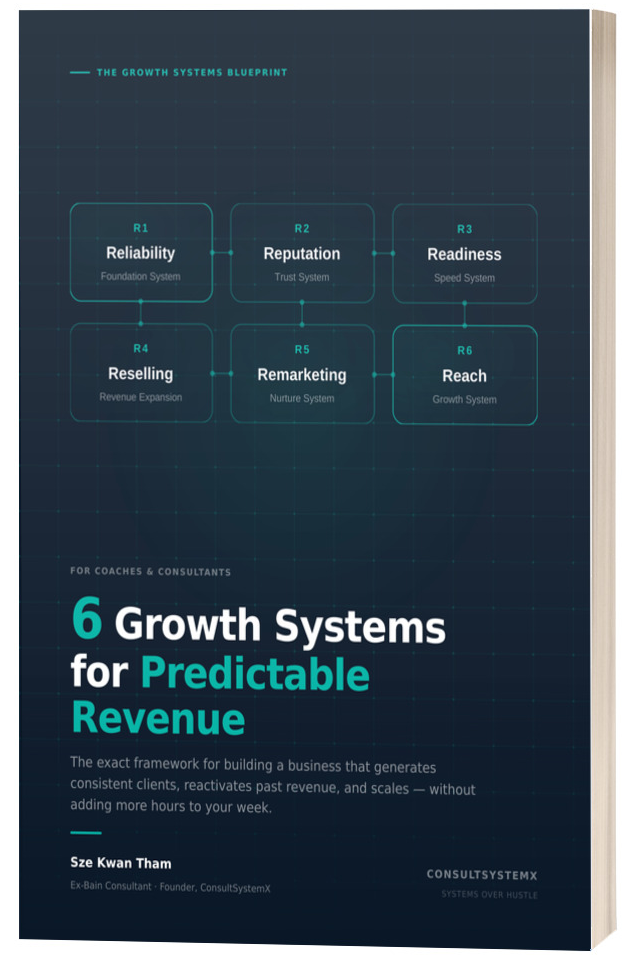
In the framework I use, this capability is called Readiness: being ready for a prospect whenever they reach out, rather than whenever you happen to be free.
What response-time targets should a small firm aim for?
A small firm should aim for an automatic acknowledgment within minutes on every channel and a personal reply within the hour during working hours. These are the targets I'd set, channel by channel. They're operating goals, not findings from a study:
Response-time targets:
Phone: answer within 3 rings
Text: reply within 5 minutes
Live chat: reply within 30 seconds
Email: reply within 1 hour
Missed call: text back within 60 seconds
Two more: reply to LinkedIn and other social messages within three hours, and when a prospect who'd gone quiet replies, call or write back personally within four hours. A returning prospect is often the warmest lead you have that week.
Outside working hours, the acknowledgment still goes out at once, and your personal reply comes first thing the next working morning.

Where to start, by firm size:
Solo: set up the automatic acknowledgment with your booking link, and the missed-call text. That covers most of the gap in an afternoon.
Two to five people: add one shared inbox and a named owner for first replies each day.
Six to ten people: add reply windows for each partner and a weekly look at actual response times, so slow weeks show up before they cost you.
What are the instant-response options?
The three instant-response options are an auto-text, a website chat and a booking link, and most small firms need at least two of them. Pick by where your inquiries come from:
Option | Best for | What it asks of you |
|---|---|---|
Auto-text after a form or missed call | Firms that get phone calls or form inquiries | Write the message once |
Website chat with an out-of-hours message | Firms whose website gets steady visits | Write the out-of-hours message and check the inbox at reply windows |
Booking link in every first reply | Every firm | Keep your real availability up to date |
Here's an acknowledgment you can adapt for a form inquiry or a missed call:
"Hi [Name], thanks for getting in touch. I'm with a client right now and will reply personally by [time]. If it's easier, you can pick a time to talk here: [booking link]. No need to reply to this message."
"No need to reply" lowers the stakes. The prospect doesn't have to compose anything, and the booking link gives them a way to act on their interest right away.
If you use a website chat, the out-of-hours message does the same job:
"I'm with a client right now. Leave your question here and I'll reply personally by [time], or pick a time to talk: [booking link]."
Put the same booking link everywhere a prospect looks for a next step: your email signature, your website's contact page, your LinkedIn profile and the confirmation email after a form. Add one question to the booking form, such as "What's the main outcome you want in the next 90 days?" You'll arrive at the call prepared, and so will they.
One setting matters more than the wording: the moment a prospect replies or books, every automatic message to them stops. Nothing undermines a fast reply like a second automated message arriving after they've already booked.
The acknowledgment is the first piece of an automated lead follow-up system; what happens over the following days and weeks is the rest of it.
How do you respond fast without being on your phone all day?
You respond fast without living on your phone by letting the acknowledgment and booking link handle the first minute, then replying personally at set windows. Two or three windows a day, before your first client session, at lunch and after your last, keep every personal reply inside a few hours.
Before I built this for my own practice, every inquiry waited for me. When I was with clients, prospects waited. When I was asleep, they waited longer. The first time it worked differently, a lead came in at 2:34 in the morning. By the time I woke up, they'd had an answer, read about how I work and booked a call. I hadn't touched anything.

That's the shift worth making. You don't need to be faster. You need the first reply to stop depending on where you are.
A few small habits help:
Agree the next date before any call ends, and send the calendar invite while you're still on the line.
Keep a three-line reply template for your windows: their question in your words, your answer, one next step.
Review last week's response times every Friday. It takes five minutes and keeps slow weeks from becoming slow months.
Get the free D6R Growth Blueprint
Response time is one part of a bigger system. The free D6R Growth Blueprint shows how Readiness fits with the other five pieces behind consistent clients, with a self-assessment for each and a 90-day roadmap. Get the free D6R Growth Blueprint.
Frequently Asked Questions
What does speed to lead mean?
Speed to lead means the time between a prospect's first contact and your first reply that gives them a next step. It's measured from when the inquiry arrives, not from when you see it.
How quickly should you respond to leads?
Respond to leads with an automatic acknowledgment within minutes and personally within the hour during working hours. Research published in Harvard Business Review found that firms replying within an hour were about 7x more likely to qualify a web lead than firms that waited an hour longer.
How do you respond fast without being on your phone all day?
You respond fast by automating the first minute, with an acknowledgment, a booking link and a missed-call text, and replying personally at two or three set windows a day.
What is a good response time for a coaching or consulting business?
A good response time for a coaching or consulting business is an acknowledgment within five minutes on every channel and a personal reply within an hour during working hours. Outside working hours, reply personally first thing the next working morning.
Does speed to lead matter for high-ticket services?
Speed to lead still matters for high-ticket services, because a fast, clear first reply is the first evidence of how you'll work together. The research isn't specific to consulting, so treat the exact multipliers as rough.
Is the five-minute rule real?
The five-minute rule comes from the 2007 InsideSales.com and MIT study, which compared calling within 5 minutes with calling at 30 minutes. It's a real finding about reaching and qualifying web leads, but it says nothing about closing deals.